
The Day the Production Line Stopped — And What It Revealed
It started like any other shift. Machines were running. Operators were in position. Orders were lined up. But by mid-day, something felt off. The numbers didn’t match the effort. The line was working… yet not delivering.
What seemed like a normal production day uncovered something much bigger — hidden bottlenecks silently limiting performance.
This is what they found.
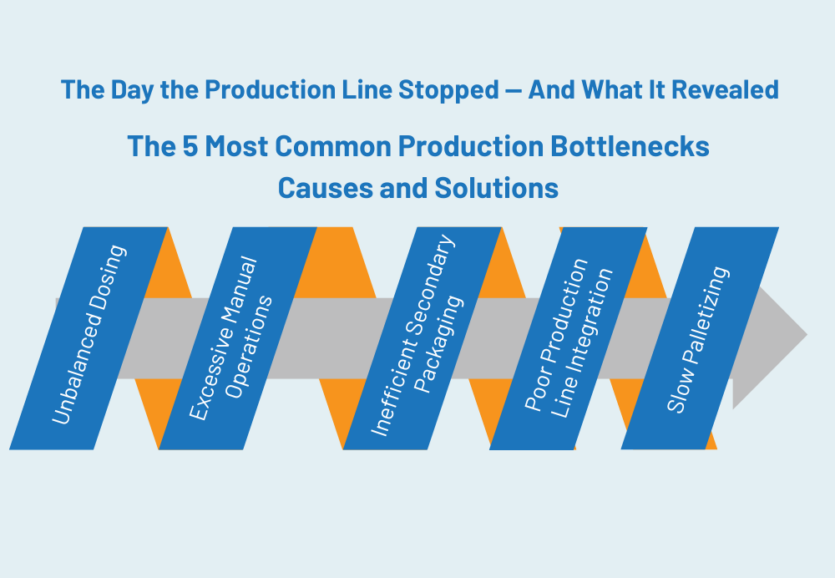
Bottleneck #1: The Line That Couldn’t Breathe
At the beginning of the process, everything depended on one thing — flow. But the dosing wasn’t consistent. Products came in waves — too fast, then too slow.
The result?
Frequent micro-stoppages no one initially noticed.
The turning point:
They implemented automated dosing with real-time monitoring.
Suddenly, the line stabilized. Without interruptions. No stress.
The line finally “breathed” again — smoothly and continuously.
Bottleneck #2: When Good People Become the Limitation
Further down the line, skilled operators were doing everything manually — handling, forming boxes, loading. They were fast. But not fast enough. As demand increased, this became the bottleneck.
The solution:
Industrial robots took over repetitive tasks.
The impact was immediate:
- faster cycles
- fewer errors
- more consistent output
People didn’t lose their value — they shifted to higher-impact roles.
Bottleneck #3: Packaging That Slowed Everything Down
Ironically, the most “simple” part of the line caused the biggest delays. Secondary packaging couldn’t keep up. Frequent format changes created downtime.
The fix:
A flexible automated case packing system with robotic handling.
What changed?
Packaging stopped reacting — and started leading the pace.
Bottleneck #4: Machines That Didn’t Work Together
Each machine was optimized individually. But together? Not really. Speed mismatches caused waiting. Waiting caused inefficiency.
The breakthrough:
A centralized control system with full line synchronization.
The result:
The entire line started operating as one connected system.
No more gaps. No more conflicts. Just flow.
Bottleneck #5: The Final Barrier — Palletizing
Everything was running faster… until the end. Products started piling up. Manual palletizing couldn’t keep up.
The solution:
Robotic palletizing with optimized patterns and automated transport.
The outcome:
A fully continuous process — from start to finish.
What Changed After That?
Within weeks, the results were clear:
- Higher production capacity
- Less downtime
- Lower operational costs
- Better use of both people and machines
But the biggest realization was simple:
The problem was never one machine. It was the system.
The Real Lesson
Most production lines don’t fail dramatically. They underperform quietly — every single day.
Fixing one issue helps. Optimizing the entire line transforms everything.
Ready to Eliminate Your Bottlenecks?
StanTech helps manufacturers turn inefficiencies into measurable performance through advanced end-of-line solutions:
- Case packing systems
- Robotic integration
- Automated palletizing
- Full production line optimization
Contact us: 📩 sales@stantechpackaging.com
 EN
EN  ES
ES  SR
SR  RU
RU